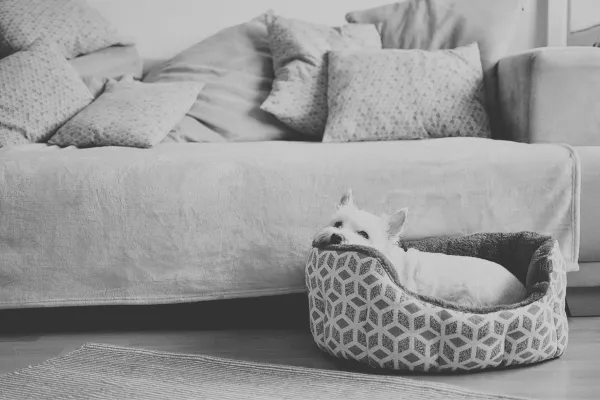
Why Teaching Your Dog to Settle Might Be the Most Important Skill You’ll Ever Install
There is a specific kind of exhaustion that comes from living with a dog who never truly powers down.
They follow you from room to room.
They pop up every time you stand.
They bark at small sounds.
They struggle to lie still when guests are over.
They pace while you’re on work calls.
They aren’t “bad.”
They’re just alert.
And in many homes, constant alertness quietly becomes normal.
If you are searching for puppy training in Hillsborough NC or dog training in Chapel Hill NC, chances are you’re focused on obedience skills. Sit. Down. Stay. Recall. Leash manners.
Those matter.
But none of them regulate the nervous system.
Settling does.
The Skill Most People Skip
We teach dogs to move constantly.
Walk nicely.
Come when called.
Play fetch.
Engage.
Focus.
Very few families intentionally teach their dog how to do nothing.
And yet, in a high-functioning household — where work calls, social events, travel, and movement are part of daily life — the ability to settle calmly may be the single most important behavior a dog can learn.
A dog who can truly relax:
• Handles guests without escalating
• Rests during dinner parties
• Lies quietly under a table at a brewery
• Stays neutral when you move around the house
• Recovers faster from stimulation
That is not personality.
That is trained emotional regulation.
Why “Place” Isn’t the Same as Calm
Many families attempt to teach a “place” command.
The dog goes to a bed.
The dog stays there.
But the body is tight.
The eyes track movement.
The nervous system is still elevated.
Obedience is compliance.
Settling is regulation.
When we teach a dog to settle properly, we are not just teaching duration. We are shaping breathing, body softness, eye tension, and recovery speed.
That level of calm does not happen accidentally.
Puppies Don’t Automatically Grow Out of It
A common assumption is that high energy will fade with age.
Sometimes it softens.
Often it solidifies.
If a puppy rehearses constant hyper-vigilance, following, or over-arousal, those patterns strengthen neurologically. By adolescence, what once looked “cute and busy” begins to feel disruptive.
This is why early puppy training in Hillsborough NC or Efland NC should include intentional relaxation work from the beginning.
Prevention is dramatically easier than correction.
The Cost of a Dog Who Cannot Settle
This is where the frustration builds quietly.
You avoid certain public locations.
You hesitate to host.
You manage constantly instead of relaxing.
You feel slightly on edge in your own home.
It’s rarely dramatic enough to feel like a crisis.
It’s just… draining.
For pet parents who value a calm, well-run household, this matters more than they admit.
A dog who can settle changes the emotional tone of the entire home.
What Real Settling Looks Like
A truly settled dog:
• Lies down without being micromanaged
• Softens their body naturally
• Stops scanning every movement
• Recovers quickly after excitement
• Does not need constant redirection
This is not suppression.
It is nervous system balance.
And it can be trained.
If Your Dog Follows You Everywhere
If your dog pops up every time you move…
If they cannot stay settled when there is normal life happening around them…
If you feel like you are constantly managing energy instead of enjoying your dog…
That is not personality.
That is an untrained settle response.
And the earlier it’s addressed, the easier it is to shape.
A Structured Way to Build It
Inside my 15 Day Chill Out Challenge, we focus exclusively on this skill.
Not flashy obedience.
Not tricks.
Just teaching your dog how to power down.
Over 15 structured days, you’ll build:
• Duration
• Disengagement from movement
• Calm recovery after stimulation
• True relaxation, not just compliance
It’s the same foundation I use inside private training and Board & Train programs in Hillsborough and Chapel Hill.
Because without the ability to settle, every other skill feels fragile.
Grab a copy of the workbook HERE
Calm Is a Design Choice
Some dogs appear naturally relaxed.
Most are trained that way.
If your home feels slightly louder, slightly busier, or slightly more tense than you’d like, this is where to begin.
You don’t need more commands.
You need a system that teaches your dog how to rest.
And once that’s installed, everything else becomes easier.
